
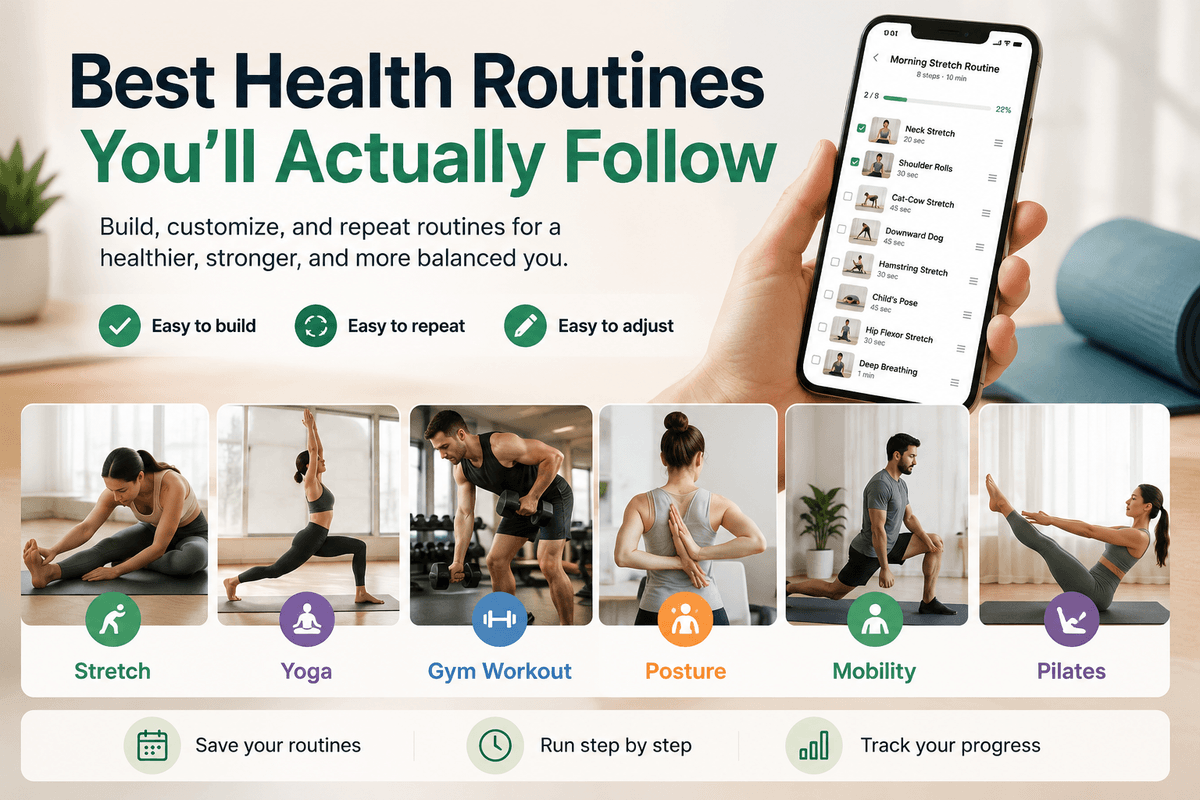
Best Health Routines You’ll Actually Follow
Most health routines fail for a simple reason: they are too hard to repeat.
A routine can look good in a video, app, notebook, or saved article, but that does not mean you will actually do it tomorrow. The best health routine is not the longest one, the most intense one, or the one with the most exercises. It is the one you can start, follow, adjust, and repeat.
That is why we have been building routine tools in Checklist. Instead of starting from a blank list each time, you can choose a routine, customize the steps, save it, and run it again when you need it.
You can browse all routine checklist templates, or start with one of the six health routines below.
What makes a health routine easier to follow?
A good routine removes decisions.
You should not have to ask yourself what to do first, how long to hold a stretch, which exercise comes next, or whether you are finished. A repeatable routine gives you a clear structure.
The routines that usually work best are:
- Specific - you know what the routine is for.
- Short enough to start - it does not feel like a project.
- Step by step - each task leads into the next.
- Reusable - you can save it and run it again.
- Flexible - you can change timing, reps, exercises, or order.
- Easy to repeat - it fits into your real life.
That is the idea behind our new health routine builders: build once, adjust when needed, and run the routine step by step.
1. Stretch routine
A stretch routine is one of the easiest health routines to start because it does not require equipment, much space, or a long time commitment.
Use a stretch routine when you want to:
- loosen up after sitting
- stretch after a workout
- prepare before running or walking
- build a short morning or evening movement habit
- create a simple full-body stretching flow


With the Stretch Routine App, you can choose stretches, adjust the order, set timing, and save the routine for later. This is useful if you want something more structured than a random stretch video, but simpler than a full workout plan.
A good first stretch routine can be as short as five minutes. Pick a few stretches for your neck, shoulders, hips, hamstrings, and back. Save it. Run it again tomorrow.
2. Yoga routine
Yoga is often easier to follow when the routine has a clear beginning, middle, and end.
A reusable yoga routine can help when you want:
- a short morning flow
- a calming evening routine
- a beginner-friendly yoga sequence
- breathing and gentle movement
- a simple routine for flexibility, balance, or relaxation


The Yoga App lets you build a yoga routine from poses and simple flows. You can start from a preset, remove poses you do not want, change timing, and save your version.
This works well if you do not want to search for a new yoga video every time. You can keep your own routine ready and run it when it fits your day.
3. Gym workout routine
Gym routines are easy to overcomplicate.
You may have a plan in your head, notes in your phone, saved workouts from different sources, and a rough idea of what you want to train. But once you are in the gym, it helps to have the exact routine ready.
A gym workout routine can include:
- exercises
- sets
- reps
- rest time
- order
- warm-up and cooldown steps


The Gym Workout App helps you build a custom gym workout that you can save and repeat. This is useful for full-body workouts, strength sessions, beginner routines, or a simple weekly gym structure.
You do not need to build a perfect plan on day one. Start with a routine you can complete. Then adjust exercises, sets, reps, and rest as your training improves.
4. Posture routine
Posture routines are useful because they are usually small enough to fit into the workday.
You do not need a full workout to reset your posture. A few focused steps for the neck, shoulders, chest, and upper back can already make the routine feel useful.
A posture routine is especially helpful if you:
- work at a desk
- sit for long periods
- use a laptop often
- feel tight through the shoulders or chest
- want a short work break routine


The Posture Workout App lets you build a short desk posture routine and run it during breaks. You can choose exercises for common posture goals such as tech neck, rounded shoulders, upper-back reset, or general desk posture.
A posture routine works best when it is short. If it only takes a few minutes, you are more likely to actually do it.
5. Mobility routine
Mobility routines are useful when you want movement that is more active than stretching, but not as intense as a workout.
A mobility routine can help you work through joints and movement patterns such as:
- hips
- shoulders
- ankles
- spine
- lower back
- full-body movement


The Mobility Workout App helps you build a reusable mobility routine for mornings, warm-ups, recovery, travel days, or desk breaks.
Mobility routines are often best when they are practical. You can create a five-minute routine for daily movement, a longer routine for warm-ups, or a focused routine for hips, shoulders, ankles, or back.
6. Pilates routine
Pilates routines are useful when you want controlled movement, core work, and low-impact strength.
A Pilates routine can be a good fit for:
- beginner mat Pilates
- core-focused routines
- full-body low-impact workouts
- chair Pilates
- wall Pilates
- gentle movement days


The Pilates Workout App lets you build a Pilates routine from selected exercises, adjust timing or reps, and save the result.
This is useful if you want a routine that is more personal than a fixed plan, but still structured enough to follow step by step.
How to choose the right routine to start with
If you are not sure where to begin, start with the routine that removes the most friction from your week.
Choose:
- Stretch if you want something simple and flexible.
- Yoga if you want a calmer routine with breathing and movement.
- Gym if you want structured workouts you can repeat.
- Posture if you sit at a desk and want short work breaks.
- Mobility if you want active movement for joints and warm-ups.
- Pilates if you want controlled, low-impact strength and core work.
The best first routine is usually not the most ambitious one. It is the one you can do again.
Start with 5 to 15 minutes. Keep the steps clear. Save the routine. Then repeat it enough times to know what should change.
Build routines instead of starting over
A checklist is useful for making sure you do not miss anything. A routine goes one step further: it gives you a repeatable structure you can run again and again.
That matters because health habits are rarely one-time tasks. Stretching, workouts, posture resets, mobility work, yoga, and Pilates all become more useful when they are repeated.
With Checklist, you can:
- choose a routine builder
- select the steps you want
- adjust timing, reps, sets, or rest where relevant
- save the routine
- run it step by step
- schedule it to build a routine you will actually follow
Browse all routine checklist templates, or start with one of the health routines above.
The best routine is the one you will actually follow!