
On This Page
- Why daily routines work better as checklists
- Start with your morning routine
- End the day with a night routine
- Morning and night routines should support each other
- Build the routine around real categories
- Add supporting routines when they make sense
- App, planner, template, or habit tracker?
- How to start without overbuilding
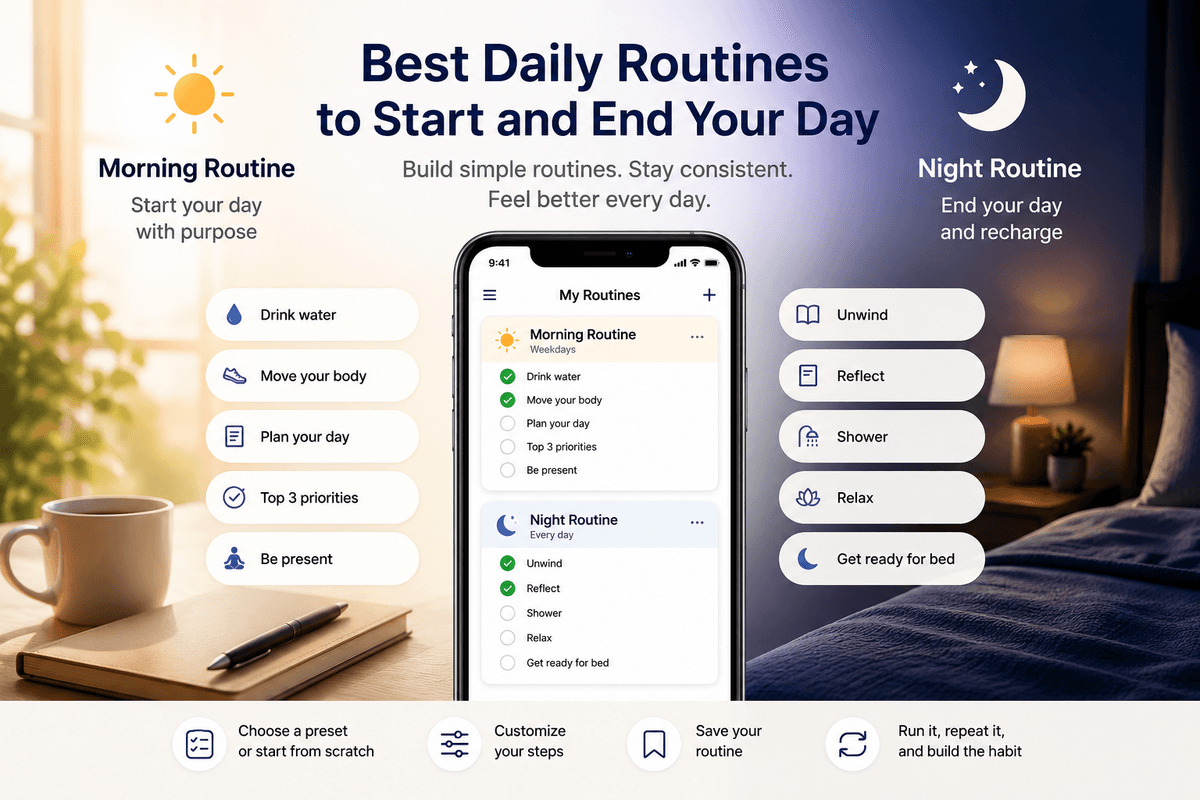
Best Daily Routines to Start and End Your Day
A daily routine is easier to follow when it is built around the two moments that repeat most reliably: the beginning of the day and the end of the day.
Your morning routine decides how you move from sleep into action. Your night routine decides how you close the day, prepare for tomorrow, and avoid carrying unfinished decisions into the next morning.
That is why we added two new routine builders to Checklist:
Both builders work the same practical way: start from a preset, customize the checklist, save the routine, then run it again when you need it. You can keep the routine simple, create a faster version for busy days, or turn it into a repeatable schedule inside Checklist.
This is not about copying someone else's perfect daily routine. It is about building a checklist that matches the way your day actually starts and ends.
Why daily routines work better as checklists
Many daily routine ideas are written like advice: wake up early, drink water, stretch, journal, plan your day, avoid your phone, read, prepare your clothes, sleep better.
Some of that may be useful. The problem is that advice is not the same as a usable routine.
A checklist turns the idea into a sequence. It answers the practical questions that matter when you are half-awake in the morning or tired at night:
- What do I do first?
- Which steps are essential?
- Which steps are optional?
- How long should this take?
- What can I skip when I am short on time?
- Can I reuse this tomorrow without rebuilding it?
That is where a daily routine checklist is more useful than a saved article, a note, or a vague habit goal. It gives you a repeatable structure you can edit as your life changes.
Start with your morning routine
A morning routine does not need to be ambitious. In most cases, the best morning routine is the one that removes the first few decisions of the day.
The Morning Routine builder lets you start from presets such as Simple Morning Routine, Quick Morning Routine, Productive Morning Routine, Healthy Morning Routine, and Calm Morning Routine.
From there, you can adjust the checklist around your real morning. For example, a weekday routine might include getting light, brushing teeth, checking the weather, packing a bag, reviewing your calendar, and choosing your top priorities. A work-from-home routine might replace the commute step with preparing your workspace and starting the first focused work block.
The useful part is that the builder does not force one morning routine template on everyone. You can use the preset as a draft, remove what does not fit, add missing tasks, and save your version.
A simple morning routine checklist might follow this shape:
- Start the day
- Handle hygiene
- Get dressed and ready
- Eat or prepare food
- Review the day
- Choose what matters first
- Leave or start work on time
That structure is enough for many people. If you want more, you can add movement, journaling, skincare, meal planning, pet care, or a small home reset.
End the day with a night routine
A night routine is not only a bedtime checklist. It is also a way to close open loops before the next day starts.
The Night Routine builder helps you create an evening checklist from presets such as Simple Night Routine, Quick Night Routine, Productive Evening Routine, Calm Night Routine, Healthy Night Routine, and Self-Care Night Routine.
This makes the night routine useful for different kinds of evenings:
- A quick version when you only want the essentials.
- A productive version for reviewing tomorrow's calendar and priorities.
- A calm version for reducing screen use, dimming lights, and slowing down.
- A self-care version for skincare, reading, stretching, or a quiet reset.
A practical night routine can include digital shutdown, tomorrow prep, hygiene, bedroom reset, light movement, reflection, and sleep setup. The exact mix depends on what causes friction in your evening.
For some people, the most valuable step is putting the phone away. For others, it is packing a bag, choosing clothes, writing down open tasks, or preparing breakfast. The point is not to make the evening longer. It is to reduce what tomorrow morning has to solve.
Morning and night routines should support each other
The best daily routine is often not one long checklist. It is two shorter routines that work together.
A night routine can make the morning easier by preparing clothes, packing a bag, reviewing tomorrow's schedule, or clearing small decisions before bed. A morning routine can then focus on getting ready, checking the day, and starting the first important task without rebuilding the plan from scratch.
This creates a simple daily loop:
- The night routine closes today and prepares tomorrow.
- The morning routine starts tomorrow with less friction.
- Both routines stay editable, so they can change when your schedule changes.
This is why it can be useful to save more than one version. You might have a normal morning routine, a quick morning routine, a calm Sunday routine, and a short night routine for late evenings. A routine planner or habit tracker can help with consistency, but a reusable checklist is better when you want the actual steps to be clear and repeatable.
Build the routine around real categories
A daily routine builder should not just give you a blank page. It should help you think in useful categories.
For morning routines, the common categories are:
- Start
- Health
- Hygiene
- Get ready
- Food
- Movement
- Mindset
- Planning
- Home
- Finish
For night routines, the common categories are:
- Start
- Digital shutdown
- Tomorrow prep
- Hygiene
- Home reset
- Self-care
- Reflection
- Sleep setup
- Finish
These categories make the checklist easier to customize. You can keep the routine balanced without adding every possible habit. For example, a morning routine does not need ten productivity tasks if the main problem is leaving home on time. A night routine does not need a long self-care section if the main problem is forgetting to prepare for tomorrow.
The best routine is usually the one with fewer steps, better order, and less ambiguity.
Add supporting routines when they make sense
Morning and night routines can also connect with more specific routines.
If movement helps you start or end the day, you can build a Stretch Routine and link it into your morning or evening flow. If you prefer a calmer movement sequence, a Yoga App routine can work well before work, after work, or before bed.
For people who plan their day task by task, a Daily To Do List can sit beside the routine. The daily routine handles the repeated sequence. The to-do list handles the changing work, errands, calls, and one-time tasks.
That split matters. A routine should not become a dumping ground for every task in your life. Keep routines for repeatable steps. Use normal checklists for everything else.
App, planner, template, or habit tracker?
Different tools solve different problems.
A planner is useful when your morning or evening is built around time blocks. A habit tracker is useful when you only care whether something happened. A printable routine template is useful when you want a visual reminder on the wall.
A checklist app is better when the routine has steps you want to edit, save, run, schedule, and repeat.
Checklist sits between a static daily routine template and a full niche routine app. You get presets and suggested tasks, but you are not locked into a fixed plan. You can build a routine once, save it, run it step by step, and improve it after using it.
That is especially useful for daily routines because they change with workdays, weekends, kids, travel, sleep, commute, exercise, and season. A good routine system should let you adjust without starting over.
How to start without overbuilding
Start with one routine, not a complete life system.
If mornings feel messy, build your Morning Routine first. Choose the preset closest to your real morning, remove anything unrealistic, and save a version you can actually run this week.
If evenings are the problem, start with your Night Routine. Add the few steps that make tomorrow easier: review the calendar, write down open loops, prepare clothes or a bag, handle hygiene, reduce screen use, and finish with a clear sleep setup.
After that, create a quick version. This is the backup routine you can still complete when the full version is too much. A daily routine becomes more useful when it survives imperfect days.
The goal is not to design the perfect routine. The goal is to build a reusable checklist that helps you start and end the day with fewer missed steps, fewer repeated decisions, and a clearer path into tomorrow.
Start with the Morning Routine, the Night Routine, or browse all routine checklist templates.