
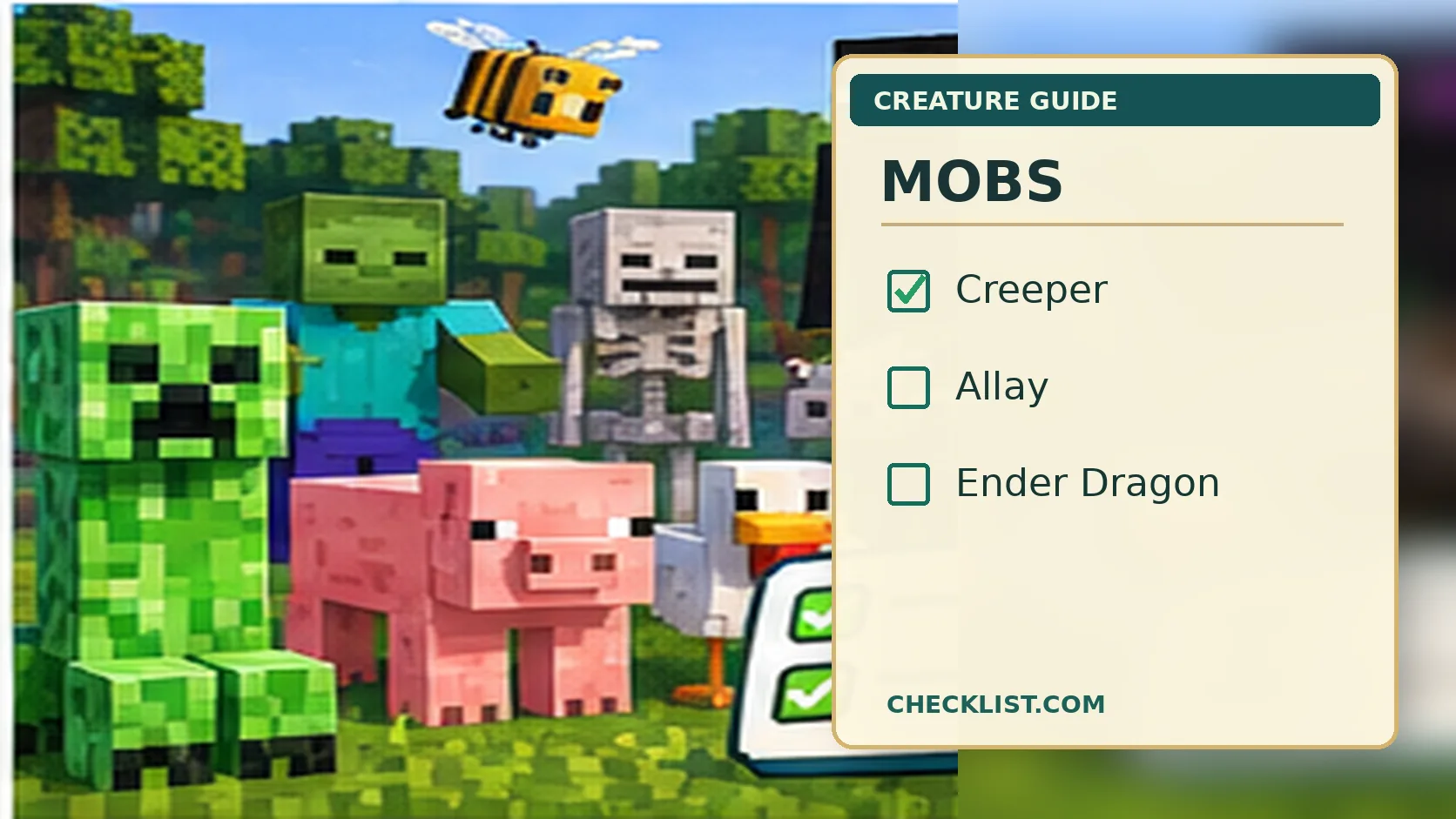
Minecraft Mobs List: Passive, Neutral & Hostile
88 mob sightings selected. Only these mob sightings will be saved.
Your checklist
88 mob sightings selected
Allay
Armadillo
Axolotl
Bat
Camel
Camel Husk
Cat
Chicken
Cod
Copper Golem
Cow
Donkey
Frog
Glow Squid
Happy Ghast
Horse
Mooshroom
Mule
Ocelot
Parrot
Pig
Rabbit
Salmon
Sheep
Skeleton Horse
Sniffer
Snow Golem
Squid
Strider
Sulfur Cube
Tadpole
Tropical Fish
Turtle
Villager
Wandering Trader
Zombie Horse
Bee
Cave Spider
Dolphin
Drowned
Enderman
Fox
Goat
Iron Golem
Llama
Nautilus
Panda
Piglin
Polar Bear
Pufferfish
Spider
Trader Llama
Wolf
Zombie Nautilus
Zombified Piglin
Blaze
Bogged
Breeze
Creaking
Creeper
Elder Guardian
Endermite
Evoker
Ghast
Guardian
Hoglin
Husk
Magma Cube
Parched
Phantom
Piglin Brute
Pillager
Ravager
Shulker
Silverfish
Skeleton
Slime
Stray
Vex
Vindicator
Warden
Witch
Wither Skeleton
Zoglin
Zombie
Zombie Villager
Ender Dragon
Wither
Choose more mob sightings
Add optional mob sightings to your routine.
Minecraft Mobs mob sighting instructions
Allay
Where / why: Woodland mansion cages and pillager outposts; helpers carry matching items. Classification: Passive.
Armadillo
Where / why: Savanna and badlands; brush scutes for wolf armor. Classification: Passive.
Axolotl
Where / why: Lush caves in underground water. Classification: Passive.
Bat
Where / why: Dark cave spaces; harmless and no ordinary drops. Classification: Passive.
Camel
Where / why: Desert villages; can carry two riders. Classification: Passive.
Camel Husk
Where / why: Warm dry regions as a skeletal-looking camel mount. Classification: Passive.
Cat
Where / why: Villages and swamp huts; tame stray cats with raw fish. Classification: Passive.
Chicken
Where / why: Many grassy Overworld regions; eggs and feathers. Classification: Passive.
Cod
Where / why: Cold and temperate oceans. Classification: Passive.
Copper Golem
Where / why: Created using copper blocks and a carved pumpkin; sorts items into containers. Classification: Passive.
Cow
Where / why: Grassy Overworld biomes; leather and milk. Classification: Passive.
Donkey
Where / why: Plains/savannas; can carry chests. Classification: Passive.
Frog
Where / why: Swamps and mangrove swamps; color depends on temperature. Classification: Passive.
Glow Squid
Where / why: Dark underground water pockets. Classification: Passive.
Happy Ghast
Where / why: Raise a dried ghast into a ghastling, then a Happy Ghast for aerial transport. Classification: Passive.
Horse
Where / why: Plains and savannas. Classification: Passive.
Mooshroom
Where / why: Rare mushroom fields; mushroom stew and milk. Classification: Passive.
Mule
Where / why: Breed horse and donkey. Classification: Passive.
Ocelot
Where / why: Jungles; wild cat-like animal. Classification: Passive.
Parrot
Where / why: Jungles; can be tamed with seeds. Classification: Passive.
Pig
Where / why: Grassy biomes and farms. Classification: Passive.
Rabbit
Where / why: Deserts, snowy and flower-rich regions, with different coats. Classification: Passive.
Salmon
Where / why: Rivers and colder oceans. Classification: Passive.
Sheep
Where / why: Grassy biomes; shear for wool. Classification: Passive.
Skeleton Horse
Where / why: Appears with skeleton horse traps during thunderstorms. Classification: Passive.
Sniffer
Where / why: Hatch sniffer egg from archaeology; finds ancient seeds. Classification: Passive.
Snow Golem
Where / why: Create from snow blocks and carved pumpkin. Classification: Passive.
Squid
Where / why: Rivers and oceans; ink sacs. Classification: Passive.
Strider
Where / why: Lava seas of the Nether; ride using warped fungus on a stick. Classification: Passive.
Sulfur Cube
Where / why: Sulfur cave biome, added in 2026; new cube-like mob. Classification: Passive.
Tadpole
Where / why: Hatches from frogspawn and matures into a frog. Classification: Passive.
Tropical Fish
Where / why: Warm ocean waters and coral reefs. Classification: Passive.
Turtle
Where / why: Beaches; eggs and scutes when babies grow. Classification: Passive.
Villager
Where / why: Villages; trade through assigned workstations. Classification: Passive.
Wandering Trader
Where / why: Randomly appears near players with trader llamas. Classification: Passive.
Zombie Horse
Where / why: Special undead horse encounter; mounted enemies may accompany it. Classification: Passive.
Bee
Where / why: Bee nests near flowers; can sting when provoked. Classification: Neutral or situational.
Cave Spider
Where / why: Mineshaft spawners; poisonous attacks. Classification: Neutral or situational.
Dolphin
Where / why: Ocean waters; guides players to treasure when fed fish. Classification: Neutral or situational.
Drowned
Where / why: Underwater zombie variant in oceans and rivers. Classification: Neutral or situational.
Enderman
Where / why: Overworld darkness, warped forests and the End; aggressive if stared at or attacked. Classification: Neutral or situational.
Fox
Where / why: Taigas and old-growth taigas. Classification: Neutral or situational.
Goat
Where / why: Mountains and slopes; may ram players or mobs. Classification: Neutral or situational.
Iron Golem
Where / why: Villages or player-built structures; defends villagers. Classification: Neutral or situational.
Llama
Where / why: Mountain and savanna areas; may spit when provoked. Classification: Neutral or situational.
Nautilus
Where / why: Oceans; can be ridden and protected with compatible gear. Classification: Neutral or situational.
Panda
Where / why: Bamboo jungles; personality traits and bamboo food. Classification: Neutral or situational.
Piglin
Where / why: Nether crimson forests and bastions; gold armor affects hostility. Classification: Neutral or situational.
Polar Bear
Where / why: Ice and snowy areas; protects cubs. Classification: Neutral or situational.
Pufferfish
Where / why: Warm oceans; poisonous defense. Classification: Neutral or situational.
Spider
Where / why: Surface and cave darkness; neutral in bright light under some conditions. Classification: Neutral or situational.
Trader Llama
Where / why: Travels with wandering traders. Classification: Neutral or situational.
Wolf
Where / why: Taigas and forest-related biomes; tamed with bones. Classification: Neutral or situational.
Zombie Nautilus
Where / why: Undead nautical mob found in ocean environments. Classification: Neutral or situational.
Zombified Piglin
Where / why: Nether; becomes hostile when attacked. Classification: Neutral or situational.
Blaze
Where / why: Nether fortress spawners; drops blaze rods. Classification: Hostile.
Bogged
Where / why: Swamps and trial chambers; shoots poisoned arrows. Classification: Hostile.
Breeze
Where / why: Trial chambers; launches wind charges. Classification: Hostile.
Creaking
Where / why: Pale Garden at night; linked to a creaking heart. Classification: Hostile.
Creeper
Where / why: Dark spawning areas; explosive mob. Classification: Hostile.
Elder Guardian
Where / why: Ocean monuments; Mining Fatigue. Classification: Hostile.
Endermite
Where / why: Can appear after thrown Ender Pearls. Classification: Hostile.
Evoker
Where / why: Woodland mansions and raids; drops Totem of Undying. Classification: Hostile.
Ghast
Where / why: Open Nether spaces; attacks with fireballs. Classification: Hostile.
Guardian
Where / why: Ocean monuments; ranged laser attack. Classification: Hostile.
Hoglin
Where / why: Crimson forests; hostile adult hog-like mob. Classification: Hostile.
Husk
Where / why: Deserts; does not burn under sunlight like regular zombies. Classification: Hostile.
Magma Cube
Where / why: Nether, especially basalt deltas and fortresses. Classification: Hostile.
Parched
Where / why: Dry biome skeleton variant added with Mounts of Mayhem. Classification: Hostile.
Phantom
Where / why: Appears after enough time without sleep. Classification: Hostile.
Piglin Brute
Where / why: Bastion remnant; aggressive guard. Classification: Hostile.
Pillager
Where / why: Outposts, patrols and raids; carries crossbow. Classification: Hostile.
Ravager
Where / why: Raid waves; large aggressive mount/beast. Classification: Hostile.
Shulker
Where / why: End cities; levitating projectiles. Classification: Hostile.
Silverfish
Where / why: Strongholds and infested stone blocks. Classification: Hostile.
Skeleton
Where / why: Dark Overworld environments; bow attacks. Classification: Hostile.
Slime
Where / why: Slime chunks below ground or swamps under spawn conditions. Classification: Hostile.
Stray
Where / why: Snowy regions; slows with arrows. Classification: Hostile.
Vex
Where / why: Summoned by evokers; flies through blocks. Classification: Hostile.
Vindicator
Where / why: Woodland mansions and raids; axe fighter. Classification: Hostile.
Warden
Where / why: Deep dark; summoned by sculk shriekers. Classification: Hostile.
Witch
Where / why: Swamps and raids or dark spawn; throws harmful potions. Classification: Hostile.
Wither Skeleton
Where / why: Nether fortresses; wither effect and skull drops. Classification: Hostile.
Zoglin
Where / why: Hoglin zombified outside the Nether. Classification: Hostile.
Zombie
Where / why: Dark Overworld; undead melee attack. Classification: Hostile.
Zombie Villager
Where / why: Zombie variant; can be cured into a villager. Classification: Hostile.
Ender Dragon
Where / why: Boss guarding the End's central island; drops a large XP reward. Classification: Boss.
Wither
Where / why: Summon with soul sand/soil and three wither skeleton skulls; drops Nether Star. Classification: Boss.
Passive mobs
Most passive mobs won't intentionally attack players. Find farm animals, fish and useful companions such as allays, sniffers, copper golems and Happy Ghasts. Some require specific conditions to obtain or create, rather than generating naturally.
Neutral or situational mobs
Wolves, bees, foxes, iron golems, spiders and piglins may attack when provoked or when particular conditions are met. Some aquatic mobs have distinctive behavior. Treat classification as an exploration aid rather than a combat guarantee.
Hostile mobs and bosses
Zombies, skeletons, creepers and witches are common hazards. The Nether includes blazes, hoglins and wither skeletons; the End includes shulkers. The Warden is a formidable deep-dark encounter. Ender Dragon and Wither are the two bosses.
What's in the 2026 releases?
This list includes Copper Golem, Happy Ghast, Nautilus, Zombie Nautilus, Camel Husk, Parched and Sulfur Cube. It excludes announced but unreleased mobs and excludes Minecraft Education-only NPCs. There can be edition differences in mob availability, behavior and exact counts.
Make a creature-sighting checklist
Select the mobs you want to encounter and mark a confirmed sighting without needing to kill them. This is not a duplicate of the Java Monsters Hunted advancement, which has different eligibility rules. For group challenges, browse Minecraft checklists.